← the garden
budding

Systems that learn.

A system should get better the more it’s used. The fix isn’t more AI — it’s making learning compound instead of reset.

SPIRALA spiral, not a loop — use, learn, improve, returning wider each pass. The system that compounds.

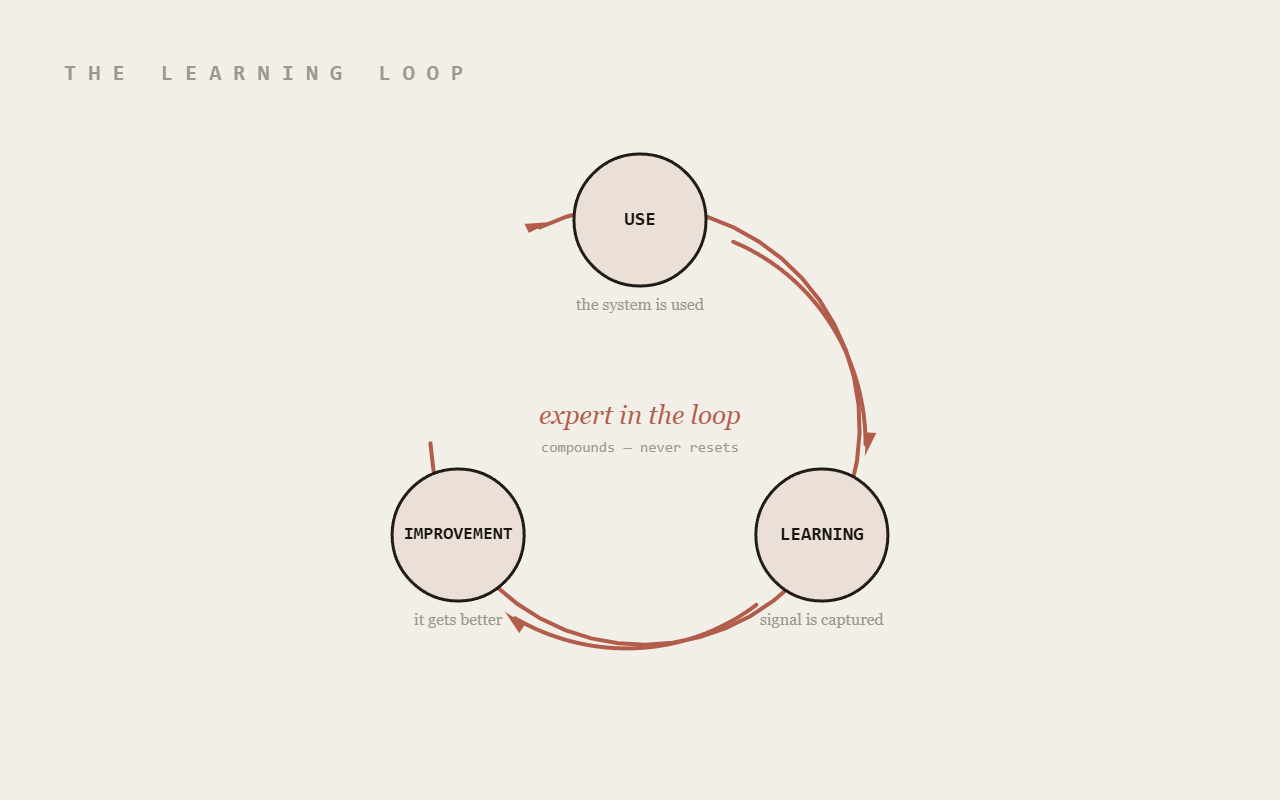
The outcome I actually want is easy to say and hard to build: a system that improves with use. Use leads to learning, learning to improvement, improvement back to use. Most systems never close that loop — every project re-learns lessons the last one already paid for.

Expert-in-the-loop is the discipline that closes it. It doesn’t change who designs or what tools they use; it changes whether learning compounds or resets. The whole trick is where the learning goes — not into new files, one-off decks, or forgotten conversations, but into system memory tied to an outcome.

Links from this note

Drift and the regulated self. →better me → better we → better me →Intelligence between the tools. →Iₜ = C( Σ(Eₜ) ± Δₜ ) →Slides are scenes. →

Linked from

better me → better we → better meWhere the damage isn’t.Intelligence between the tools.Loop-closing navigation.The pastry chef in the cockpit.Slides are scenes.CAD around the idea.
STEELMAN · SHERYL SANDBERGINE
OBJECTION

The market rewards velocity, not institutional memory. Learning loops are overhead; the teams that win just ship and re-ship and let the losers write documentation.

THE STAND

Velocity that re-learns last project's lessons is a treadmill dressed as speed. Compounding beats sprinting the moment the second project starts.

Evidence · the loop, drawn

The learning loop diagram

Use → learning → improvement → use. Expert-in-the-loop is what makes it compound instead of reset.

How it has been tended

2026-03-25
with GPT

Planted from Mind Over Tool.

2026-06-05
by hand

Centered the note on the learning loop closing instead of 'more AI'.

drift: XiTL needs a concrete example, not just the principle.